Worken: AGIBOT Introduces a New Measure of Robot Productivity
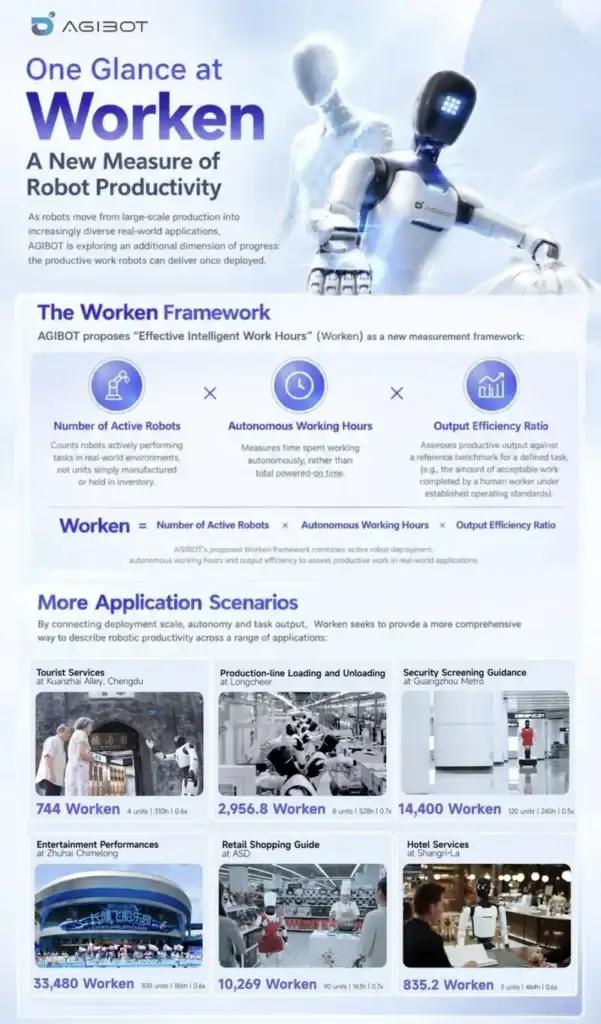
AGIBOT, the manufacturer behind the humanoid robots RaaSX offers as Benelux partner through Robots-as-a-Service, introduced Worken at AGIBOT Innovation Day 2026 in Shanghai. It is a proposed framework for expressing robot productivity in "Effective Intelligent Work Hours". The name combines work and token.
From numbers to work
News about humanoid robots usually revolves around numbers: how many robots roll off the line or have been shipped. We recently wrote about the 20,000th AGIBOT robot ourselves. Worken looks one step further and asks a more practical question: how much productive work do robots deliver once they are actually deployed?
The formula
Worken = Number of Active Robots × Autonomous Working Hours × Output Efficiency Ratio
- Number of Active Robots: counts robots actively performing tasks in real-world environments, not units simply manufactured or held in inventory.
- Autonomous Working Hours: measures time spent working autonomously, rather than total powered-on time.
- Output Efficiency Ratio: assesses productive output against a reference benchmark for a defined task, for example the amount of acceptable work a human worker completes under established operating standards.

Worken in practice
AGIBOT illustrates the measure with six real-world applications:
- Tourist services, Kuanzhai Alley (Chengdu): 4 robots × 310 h × 0.6 = 744 Worken
- Production-line loading and unloading, Longcheer: 8 robots × 528 h × 0.7 = 2,956.8 Worken
- Security screening guidance, Guangzhou Metro: 120 robots × 240 h × 0.5 = 14,400 Worken
- Entertainment performances, Zhuhai Chimelong: 300 robots × 186 h × 0.6 = 33,480 Worken
- Retail shopping guide, ASD: 90 robots × 163 h × 0.7 = 10,269 Worken
- Hotel services, Shangri-La: 3 robots × 464 h × 0.6 = 835.2 Worken
Look at the hotel: with 3 robots, Shangri-La generates more Worken than the 4 robots in Chengdu, simply because they work autonomously for much longer. That difference stays invisible if you only count robots.
What this means for the Benelux
For organisations considering humanoid robots, this is the question that matters. Not how many robots you have, but what they deliver. Worken offers a shared language to build a business case and to track, after go-live, whether a robot grows in autonomy and output.
At RaaSX we always see robots as colleagues, never as replacements. The output efficiency ratio uses human work as a benchmark, but the goal stays the same: robots take over repetitive and heavy tasks, so people have time for the work where they make the difference.
AGIBOT explicitly calls Worken an evolving framework that will be refined with data from real deployments. We will be following it closely.
More information
Curious what an AGIBOT robot could deliver in your organisation? Book a consultation with RaaSX or check the current RaaS rates.
Want to know more about the robots themselves? See every AGIBOT model, price and rental option in the Benelux.