AGIBOT Unveils GO-3 Preview: Robots That Keep Learning on the Job
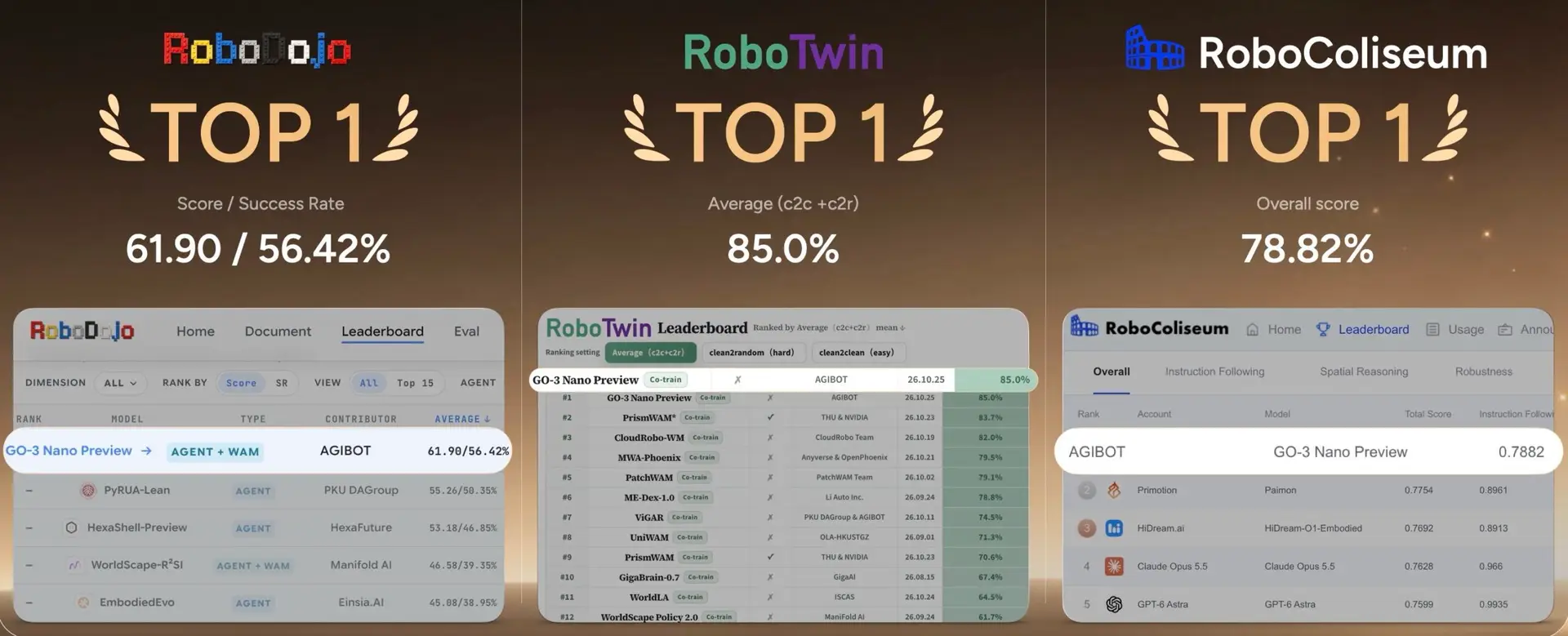
AGIBOT, the manufacturer behind the humanoid robots RaaSX offers as Benelux partner through Robots-as-a-Service, unveiled GO-3 Preview on 29 October 2026. The new embodied foundation model learns not only during training, but also afterwards and even while doing real work. GO-3 Preview ranks first on three leading embodied AI benchmarks: RoboDojo, RoboTwin and RoboColiseum. AGIBOT will fully open-source the model by the end of 2026.
Learning across the full lifecycle
Language models excel at reasoning and knowledge, but working in the physical world takes more. Picking up a small part or assembling something means anticipating change, managing contact forces and moving with precision. AGIBOT therefore takes what it calls full-lifecycle scaling: a robot learns in three stages, and each stage strengthens the next.
- GO-3 Preview, the model itself, built on AGIBOT's own WRAM architecture (World Reasoning Action Model).
- Genie Evolver, a hybrid training system for the stage after pre-training.
- Genie Master, an agent framework that lets the robot keep learning on the job.
1. Pre-training: skills that transfer
Take the instruction "pick up the cup". It could be a mug with a handle or a smooth glass, in the middle of a table or surrounded by clutter. A robot cannot memorise that; it needs general skills. WRAM combines task understanding, future-state prediction and action generation in one architecture, using three building blocks:
- CoAE extracts exactly the visual information needed for control: object positions, shapes and spatial relationships.
- SVP predicts in a single step what the situation will look like, so the robot can move purposefully towards it.
- KASO selects, from several plausible outcomes, the prediction that best matches what physically happens.
The model learns from human first-person videos, full of examples of how to handle objects, and from robot trajectories that show which movement leads to which result.
The result: the robot can perform new tasks without extra training on that task (zero-shot). For more complex operations, such as assembling LEGO, a few demonstrations are enough (few-shot).
2. Practice: in the real and the virtual world
Like people, robots improve through practice and feedback. For this, AGIBOT built Genie Evolver: a training system that combines a fleet of 100 physical robots with physics simulation and world models.
Real robots learn from each other. With Collective Experience Learning (CEL), the system pools the experience of multiple robots. What one robot learns benefits the whole fleet.
Simulation widens the practice ground. In physics simulation, robots practise under ever-changing conditions, and experiments can be repeated exactly.
World models explore alternatives. At critical decision points, the system virtually tests other actions and compares the outcomes. What works is then tried on the physical robot.
AGIBOT shows the result with a few demanding tasks. In tabletop curling, the robot has to control force and angle precisely. According to AGIBOT, after just a few hours of practice the robot won more often than typical human players.
In block extraction, each action changes the situation for the next one. The robot reassesses the stack after every step and adapts its approach. And throwing a ball into a moving basket requires it to predict and react in a split second.
3. On the job: improving in practice
However good the training, a deployed robot will always meet situations it has never seen. Until now, that often meant an engineer had to change code or collect extra data. With Genie Master, the robot learns by doing the work itself.
Genie Master introduces the Embodied Execution Protocol (EEP), with standard interfaces for what the robot can do, how a task should be done, whether the result is right and which work is still open. Experience is used in two ways: at the end of each working day, reusable knowledge goes into long-term memory, and recorded trajectories are used to further improve the robot's movements.
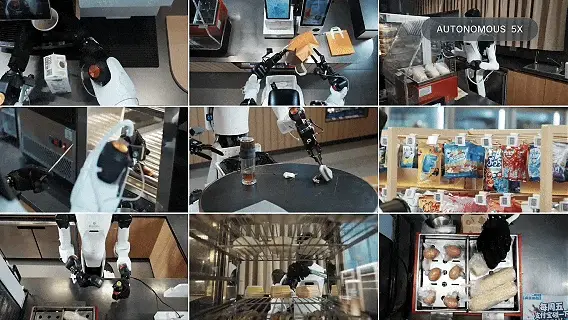
AGIBOT demonstrated this with an AGIBOT G2 in a real convenience store. The robot identified why tasks failed, adjusted its strategy and improved, without human demonstrations or manual tuning. AGIBOT calls this Physical RSI: self-improvement in the physical world, in a real business environment.
From GO-1 to GO-3
GO-1 introduced the ViLLA framework, GO-2 added action chain-of-thought. GO-3 Preview goes a step further by not stopping learning at pre-training, but extending it all the way into daily operation.
What this means for the Benelux
Until now, a robot was at its best on delivery day, and every new situation cost engineering hours. GO-3 Preview turns that around: a robot at work gets better over time, and what one robot learns can help the whole fleet.
That fits RaaSX's Robots-as-a-Service, where updates and maintenance are part of the service. Together with Genie Studio 2.0, AGIBOT's platform for building and operating robot tasks, deploying robots in practice keeps getting easier. And because GO-3 will be open source by the end of 2026, it also opens doors for education and research in the Benelux.
Our starting point stays the same: robots are co-workers, not replacements. A robot that learns by itself needs less manual work from engineers and gives people more room for the work where they make the difference.
Curious what AGIBOT robots can do in your organisation? Schedule an online meeting or call +31 30 269 0012.
Want to know more about the robots themselves? See every AGIBOT model, price and rental option in the Benelux.