264 robots per 10,000 workers, TNO now warns
The report is about industrial robots, not humanoids. The barrier it describes is exactly the same.
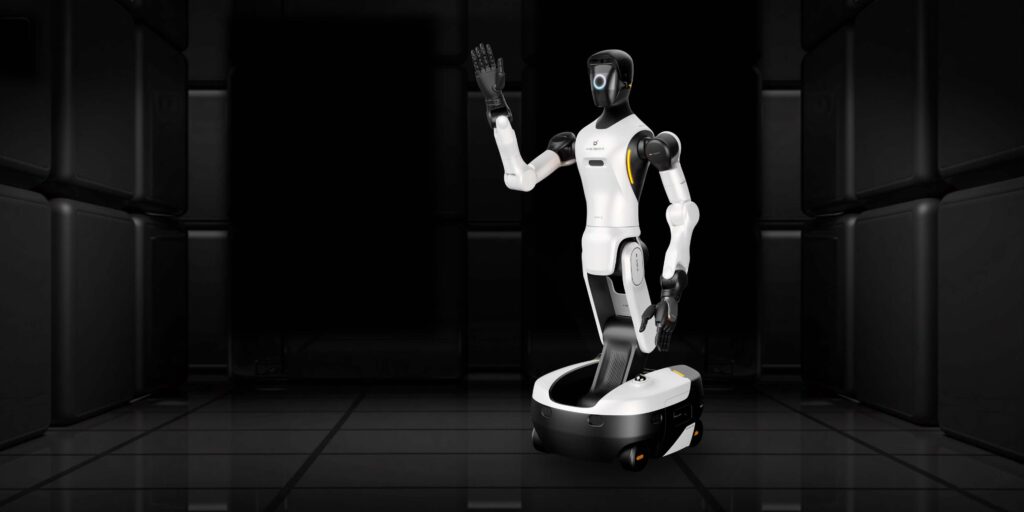
On 9 April 2026 TNO, the Dutch applied research organisation, published a report with a title that leaves little to the imagination: Without robotisation, Dutch manufacturing disappears: urgent action is required. It prompted questions in parliament. We read it with a direct interest, and we will say so up front.
The numbers
- 264 robots per 10,000 workers in Dutch manufacturing. Twelfth worldwide.
- South Korea, China and Germany sit between four hundred and well over a thousand robots per 10,000 workers.
- Productivity in Dutch manufacturing has to rise by at least 50 percent to restore its competitive position.
- Manufacturing accounts for roughly 7 percent of Dutch GDP.
The causes TNO lists are not new, which does not make them any softer: an ageing population, persistent labour shortages and high wage costs, while productivity growth stalls.
What TNO proposes
A national robotisation agenda with long-term targets, monitored by a central task force. Five recommendations:
- Awareness and knowledge sharing — national communication, insight into return and payback period, sector-specific guidance.
- Standardisation and ecosystem — open source and interoperability, strategic niches, bundling demand so system integrators see scale.
- Education and labour market — continuous learning pathways and mandatory robotics competencies.
- International positioning — the Netherlands as a European testbed for flexible robots in high-mix, low-volume production.
- Acceleration in SMEs — sector collaboration, low-threshold fieldlabs, vouchers and flexible financing models.
“Robotisation is not a luxury but a condition for keeping Dutch manufacturing,” said Mark Courage, TNO director of the smart industry division. “Only then does the Netherlands remain a maker rather than a dependent buyer.”
The sentence we noticed, and why you should distrust us on it
Recommendation five names, as an example of a flexible financing model for SMEs, robotics as a service in as many words.
That is precisely our business model. We therefore have an interest in you finding that sentence important, and you would do well to weigh that. What we think it does show: the brake on robotisation in Dutch SMEs is not primarily technical. A mid-sized manufacturer usually knows perfectly well which operation ought to be automated. It stumbles over the up-front investment, the uncertain payback period and the absence of people who can maintain the system. That is a financing and management problem, and TNO names it as such.
What the report does not say
This is about industrial robots, not humanoids. The 264 per 10,000 comes from the IFR robot density statistic and counts fixed robot arms in factories. Humanoids are not in it, and it would be dishonest to translate those figures onto our catalogue.
Where it does touch us: TNO argues for the Netherlands as a testbed for flexible robots in high-mix, low-volume production — short runs, frequent changeovers. That is exactly the gap a fixed robot arm fits badly, because every changeover costs tooling and programming again. A movable platform that works without custom tooling is a logical candidate there. That is a line of reasoning, not a proven case.
What it means in the Benelux
If you are in manufacturing, the most useful sentence in this report is not the warning but the observation that insight into return and payback period is missing. That is a concrete, solvable complaint.
What we do about it: for every request we work through the payback case per station before a contract is on the table, and you can rent before you commit. Not because that is noble, but because a deployment that does not pay off is a loss for us too.
The caveat
TNO is a research organisation with its own position in the smart industry landscape, and a report arguing urgency is also a report asking for policy and budget. The robot density figures come from an external source and are checkable; the conclusion that manufacturing disappears without intervention is a forecast, not a measurement. Read the full report yourself before you base policy on it.
Based on TNO 2026 R10389, Zonder Robotisering verdwijnt de Nederlandse Maakindustrie: Urgente actie is noodzakelijk and reporting by Computable (9 April 2026). Robot density: IFR World Robotics via TNO. Commentary by RaaSX, which sells Robots-as-a-Service and therefore has an interest in recommendation five.
← Back to news