Agibot G2 robots go to work on a production line
The question that decides a deployment is not whether a humanoid can walk. It is whether it holds a station for a full shift.
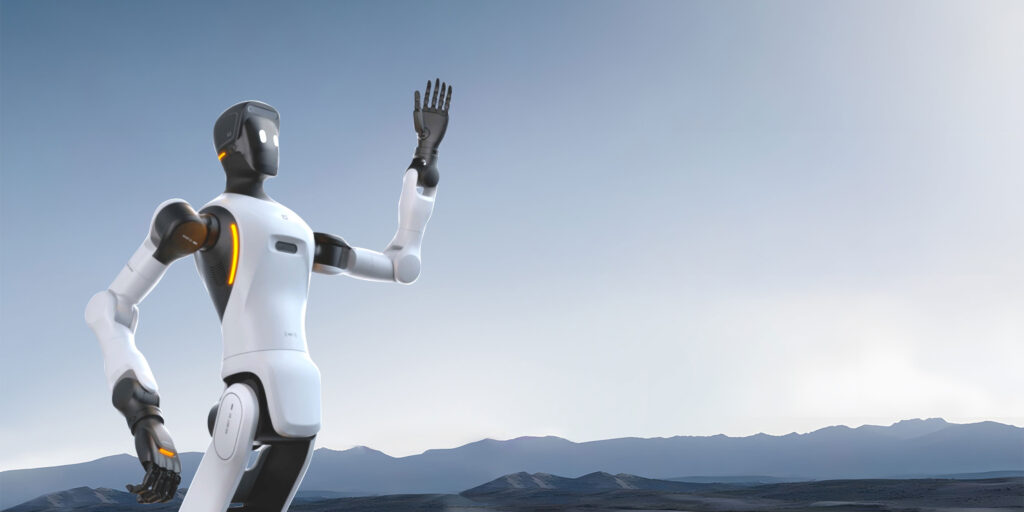
On 15 April 2026 Agibot and Longcheer Technology announced what they describe as the world’s first large-scale industrial deployment of embodied AI inside a core production workflow in consumer electronics. Not a pilot cell and not a filmed demonstration: multiple Agibot G2 robots working a live tablet line alongside human operators in Nanchang, China.
What the robots actually do
The G2 units are stationed at MMIT test stations, where they handle precision loading and unloading. They pick tablets off a high-speed line, navigate the floor, seat each device into a test fixture with millimetre accuracy and sort finished units from rejects.
Two details matter more than the task itself. The system needs no custom tooling, and it supports mixed-model production — so a changeover is a software matter rather than a mechanical one.
The numbers
- Throughput: up to 310 units per hour
- Cycle time: roughly 19 to 20 seconds per operation
- Success rate: over 99.9 percent in continuous operation
- Integration: line brought into production within 36 hours
- Output: approximately 3,000 units per shift
- Stability: more than 140 hours of cumulative continuous operation, downtime below 4 percent
Why we rate this above any stage demo
A humanoid that dances, boxes or pours a drink proves the hardware works. It says nothing about the thing a plant manager actually buys, which is a station that is still running at the end of the shift.
Cycle time and success rate are the two figures that decide whether a machine belongs on a line. Published together, across more than 140 hours, on a line with an output target, they carry more weight than any showcase.
“2026 marks the beginning of large-scale deployment for embodied intelligence,” said Dr. Yao Maoqing, who leads Agibot’s embodied business unit. Longcheer’s robotics general manager Li Long put the timeline at four months from first integration to mass production.
What it means in the Benelux
The G2 is in our catalogue: the industrial-grade dual-arm platform, available for purchase or on a 36-month RaaS contract, with rental on request. Current rates are on the G-Series page.
A Benelux plant with a comparable station — test loading, tray handling, visual sorting, machine tending — is looking at a task family the platform has now demonstrably held for days at a stretch. That is the point where a pilot stops being research and starts being a business case.
Agibot intends to run 100 robots in comparable deployments by the third quarter of 2026, and to extend the same approach into automotive, semiconductors and energy.
The caveat
These figures come from Agibot and Longcheer, not from an independent audit, and they describe one task family on one line. A different station, a different product mix and a different floor layout will produce different numbers. What the deployment establishes is that this class of task is within reach — not that your specific station is. That is what a pilot is for.
Based on the joint announcement by Agibot and Longcheer Technology of 15 April 2026, and reporting by The Robot Report. Commentary by RaaSX.
← Back to news