Humanoid Robots in Education: Funding Guide
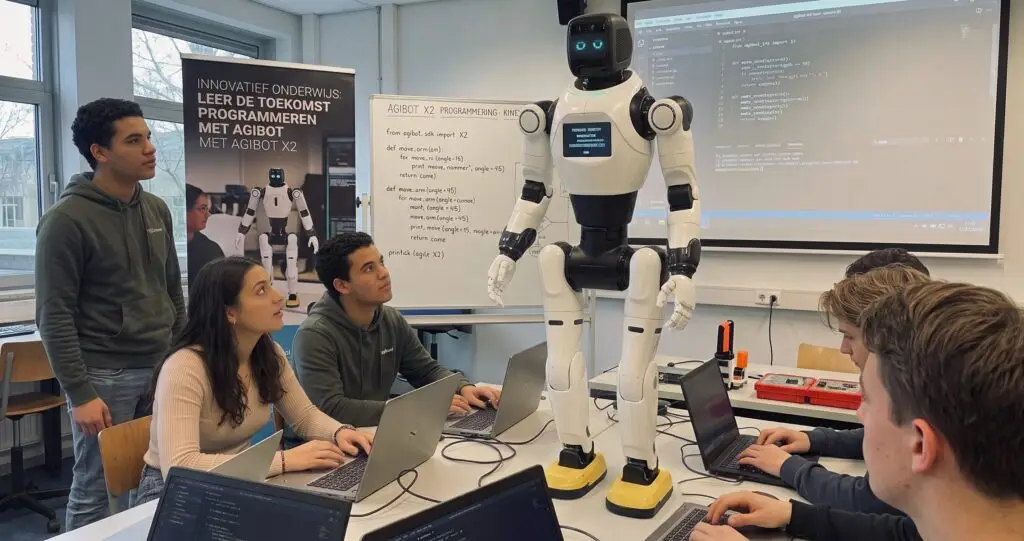
For a while, a humanoid robot in a lecture hall was mostly a demonstration: fun for an open day, not much more. That's changed. IDC now counts research and education among the five largest applications for humanoid robots worldwide, in the same list as industrial production and entertainment. And the numbers from analysts like Fortune Business Insights and MarketsandMarkets show why: the educational robot market is growing faster than the broader service robot market, with humanoid platforms as the fastest-growing segment within it.
What the research shows
What does that mean in practice? According to Counterpoint Research, which tracks global shipments quarterly, the largest share of all humanoids still goes to entertainment and data collection. Education shows up in that mix more and more often. And academic research on robots in the classroom is now honest enough to say what does and doesn't work: students are measurably more engaged when a robot is present, but the actual learning gains remain modest. For a technical programme, that's not really the point anyway. It's not about a robot that teaches: it's about students getting hands-on with sensing, manipulation and control software for the first time, on something that exists outside the lab too.
Where Agibot positions itself
Agibot isn't shy about that position. Based on the same IDC ranking, the company calls itself number one in five application scenarios at once, including research and education, and uses that as proof its platform is broad enough for more than one market. That shows in what they actually build: alongside the heavier industrial models, Agibot has dedicated entry-level platforms built specifically for research and education, with open middleware and SDKs, so a faculty can build on it themselves instead of being locked into a closed system. At RaaSX, that's the X-Series and A-Series, both listed on the Education page.
Funding: how a humanoid robot fits into an existing route
Techkwadraat, RIF and RAAK are familiar territory for most Dutch education institutions: the question isn't what they are, it's how a humanoid robot actually fits in.
For primary/secondary schools: a humanoid robot doesn't sell itself as a standalone teaching tool within Techkwadraat. It only becomes fundable as part of a continuous learning line within the region, tied to, say, a technology & application track, not as a one-off purchase.
For vocational education (mbo) via RIF, the key is the partnership. A robot "for the lessons" is a weak application; a robot deployed in a project where an employer co-funds and co-develops (for example to test a specific work instruction) fits RIF's actual purpose better: connecting vocational education to the labour market.
For universities of applied sciences via RAAK, it works the other way round: start with the research question, not the robot. RAAK applications are judged on the research (embodied AI, human-robot interaction) not the equipment. The robot is instrumental, not the subject.
The practical tip that applies to all three: don't apply for ownership of the robot, apply for the programme the robot is an instrument in. Build a RaaS structure into the application itself instead of a purchase: that keeps the budget flexible and avoids ending up, once the project closes, with a machine nobody's paying for anymore.
What RaaSX can bring to this
For an institution considering this for the first time, the first question isn't which robot: it's whether the task in mind is actually worth it. That's where RaaSX's consultancy starts: a no-obligation intake, a site visit, and a written verdict, including the honest answer if a humanoid turns out to be the wrong solution for what a faculty or research group had in mind. If there's already a draft plan, a quote, or an ongoing pilot, that gets reviewed just as critically for risks and untested assumptions.
If that turns up a task worth pursuing, there are three ways forward, not one. Renting a unit for a week to test the task on a real machine first. A multi-year RaaS contract for structural use, with a single monthly fee and the obsolescence risk sitting with RaaSX instead of the institution. Or simply buying the machine, if that fits better with how an institution accounts for investments, for example on a RIF or RAAK project where co-funding already argues for outright ownership. Which route makes sense depends on whether it's a temporarily funded pilot or a permanently established research group.
Next step
For faculties, research groups and technology regions who want to explore this further: the Education page shows which platform fits where, and an intake is usually the fastest way to match the right funding route with the right model.
Want to know more about the robots themselves? See every AGIBOT model, price and rental option in the Benelux.