Morgan Stanley: 1 Billion Humanoid Robots by 2050
Investment bank Morgan Stanley has published one of the most comprehensive analyses to date on the rise of humanoid robots: "Humanoids: Investment Implications of Embodied AI". The conclusion is clear — this is not a hype that will blow over, but a structural shift that will take shape over the coming decades.
The numbers
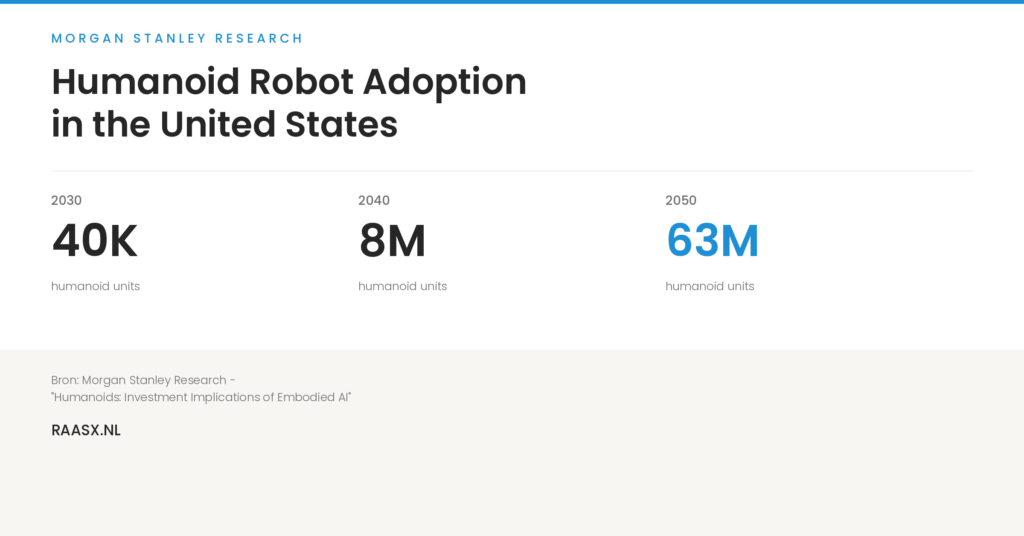
According to Morgan Stanley's analysts, the global number of humanoid robots will grow to more than 1 billion units by 2050. In the United States alone, the bank forecasts a build-up from 40,000 robots in 2030, to 8 million in 2040, to 63 million in 2050 — more recent estimates are even higher. China is seen as the current leader in production and adoption, with an expected 302 million units by 2050, followed by the US with over 77 million.
Why now?
Two developments reinforce each other according to the report:
- Labour shortages and an ageing population. Sectors such as logistics, manufacturing, healthcare and agriculture are structurally short of staff for heavy, repetitive or dangerous work.
- Falling costs and faster AI development. The build cost of a humanoid robot currently ranges between $10,000 and $300,000, with further declines expected from economies of scale and cheaper components from China.
Notably, the report compares humanoids to self-driving cars: according to Morgan Stanley, humanoid robots are technically easier to develop, because they do not have to operate in the unpredictable, complex environment of public traffic.
Adoption path: industry first, then the home
The analysts expect early adoption from 2028 to take place mainly in manufacturing, warehousing, logistics and food prep. Only after 2040 does adoption accelerate in healthcare, recreation and eventually consumer markets — households. By 2050, around 90% of all humanoids will still be deployed for industrial or commercial work; household use remains relatively limited (roughly 80 million units).
Not job losses, but a solution to a shortage
An important nuance from the report: Morgan Stanley does not primarily see this rise as job losses, but as a response to work that people simply no longer want or are able to do. The analysts point to sectors such as construction (up to 70% impact) and agriculture/fishing/forestry (up to 67%) where chronic understaffing is already the case.
What this means for the Benelux
Morgan Stanley's figures cover the US and the world as a whole, but the underlying trend — an ageing population, a tight labour market in logistics and healthcare, and falling hardware costs — applies equally to the Netherlands and Belgium. For companies that want to start experimenting with robotisation now without bearing the full purchase price, a Robots-as-a-Service model offers a logical first step.
Source: Morgan Stanley Research, "Humanoids: Investment Implications of Embodied AI" and follow-up publications 2024–2026.