Rent, RaaS or Buy: The Residual-Value Question
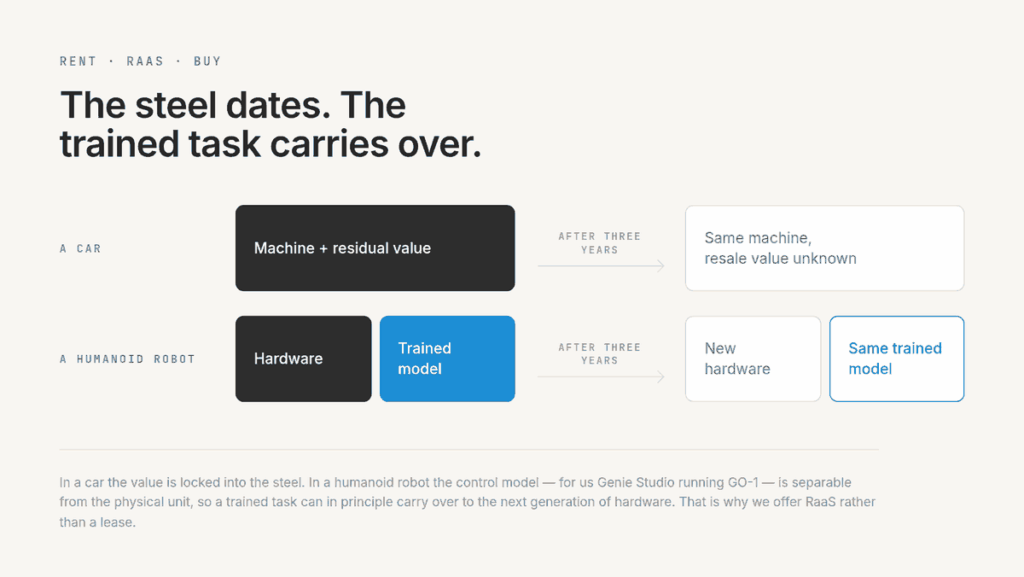
A comparison is making the rounds on LinkedIn this week: the choice between renting, leasing or buying a humanoid robot is framed as a rerun of what electric vehicles went through a few years ago. Back then the standard advice was often to lease rather than buy, because residual value was unpredictable. The post extends that logic to robots and asks the pointed question: what if the machine is technically outdated within a year?
That question is fair. It just isn’t the one that matters most.
What the comparison gets right
The uncertainty is real, and nothing new to us. With electric vehicles, the right choice genuinely depended on subsidies, tax rules, interest rates and actual resale value — factors nobody could predict with precision in advance. The same applies to humanoid robots: the hardware is moving fast, the market is barely two years old, and nobody can say with confidence what a unit will be worth on the resale market in three years. Anyone who ignores that is selling false certainty.
Where it stops holding up
Aside from software updates, a car is the same piece of steel it was when it rolled off the line. A humanoid robot isn’t. The control brain — on the machines we deploy, that’s the Genie Studio stack running the GO-1 model — is, in principle, separable from the physical unit. Adapting a task you train today typically takes on the order of 48 GPU-days for us, and that same skill can in principle carry over to the next generation of hardware, rather than staying locked to the exact unit standing on the floor today.
That changes the core question. Not: what will this robot be worth in three years? Instead: is the task we’re training now, and the model that learns it, reusable once the hardware is eventually replaced? For a car the answer is no — the engine stays the engine. For a humanoid robot the answer can be yes, and that is exactly why leasing — a fixed term tied to a fixed machine — isn’t the right model.
Why we don’t offer a lease, but RaaS
A lease buys out a piece of steel over a fixed term. RaaS buys output, and keeps the obsolescence risk — hardware and software both — on our side of the contract instead of the customer’s. That’s more than a pricing difference. It’s also why the rates track the task rather than just the machine: an X2 Basic in education, an A2 Ultra in reception or healthcare logistics and a G2 on continuous shifts each sit at a different monthly rate — priced against what the machine needs to deliver, not what it once cost.
The practical answer
Not sure whether RaaS, rental or purchase is the right form? Don’t start with residual value. Start with the task. Rent a unit for a week to test whether the task actually lends itself to automation. If it does, what you learned during that week carries over into a 36-month RaaS contract — with the obsolescence question on our side, not yours. Buying outright is still an option, but then you carry that risk yourself, and that should be a deliberate choice, not a default.